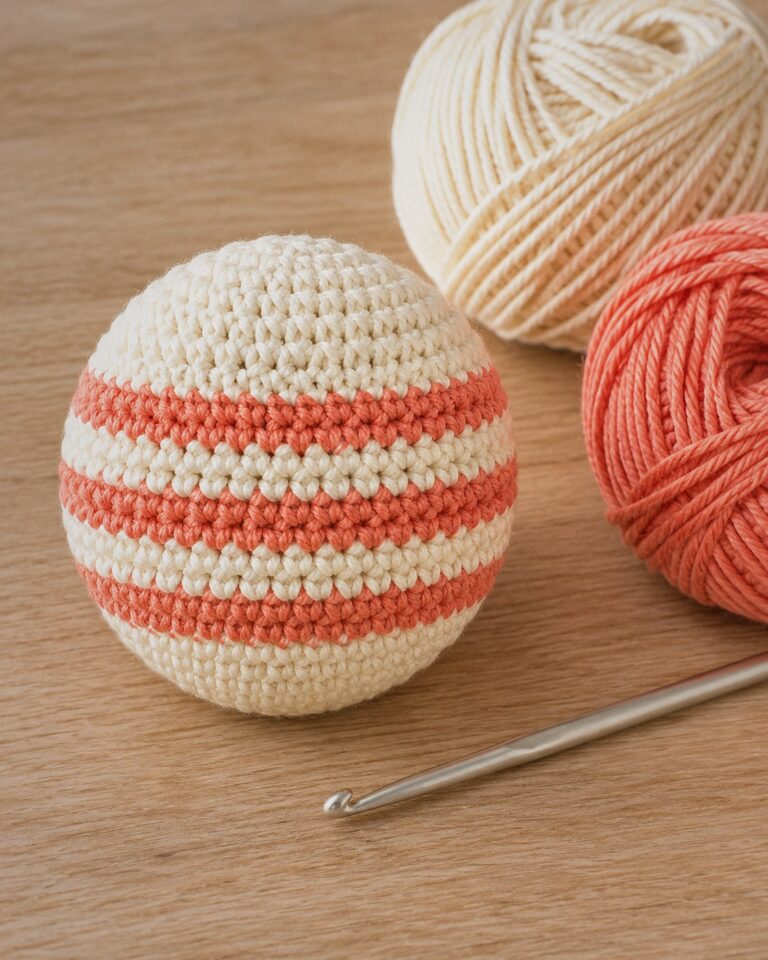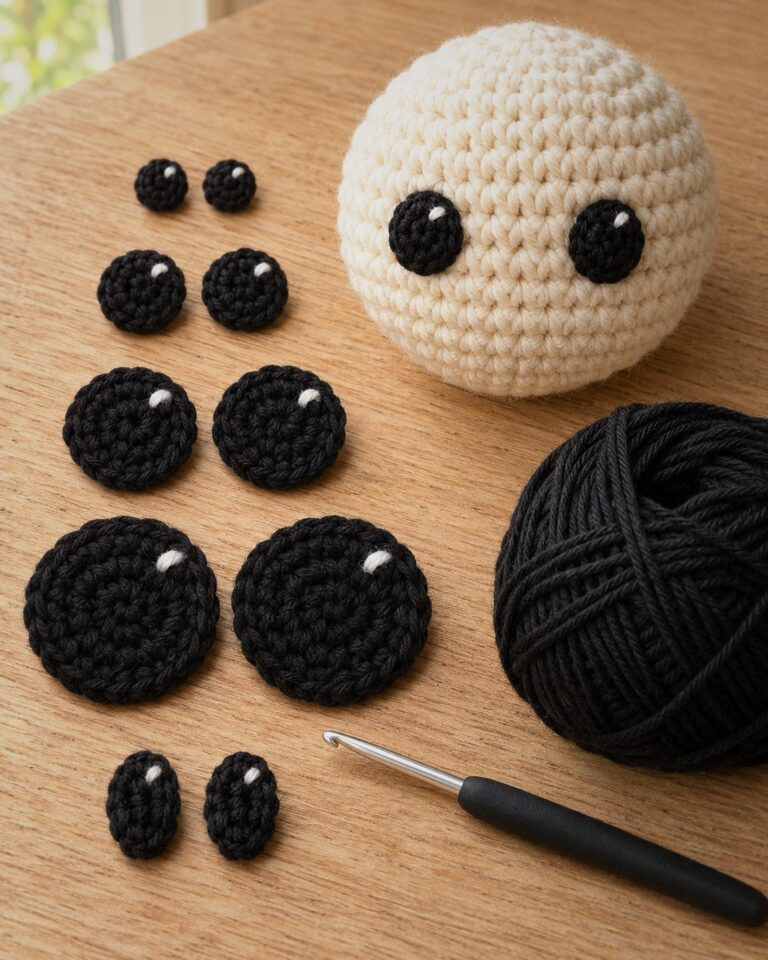
This free crochet pattern generator writes the rounds for the most common amigurumi shapes: a flat circle, a ball, or a cup or tube. Type how many stitches go in the magic ring and how wide the widest round should be, and it writes every round with the stitch count at the end, with the increases moved half a repeat on every other round so your piece comes out round instead of hexagonal.
The second calculator spreads any number of increases or decreases evenly over one round: handy when a pattern says “increase 6 stitches evenly” or when you want to change the size of a piece.
Shape calculator: circle, ball or cup
Turn on JavaScript to use the calculator, or use the table below.
Increase or decrease evenly in one round
(4 sc, inc) x6 [36]
In this post6 sections
How to use it
- Stitches in the magic ring: 6 is the standard for amigurumi. Use 8 for a flatter, wider start (for example a foot or a hat top in thicker yarn).
- Widest round: a multiple of the ring count. In DK cotton with a 2.5 mm hook, every 6 stitches is about 0.3 in / 0.8 cm of width once stuffed: 36 makes a ball about 2 in / 5 cm wide, 48 about 2.5 in / 6.5 cm.
- Rounds without increases: 0 gives a flat circle. For a ball, use about as many rounds as you had increase rounds. More makes a tube or an egg.
- Close it as a ball: adds the decrease rounds, the mirror of the increases, down to the ring count.
Why the increases move
If you always put the increase at the end of the repeat, the increases stack on top of each other and the piece grows six corners, like a hexagon. Starting every other round with half the single crochets (for example “2 sc, inc, (4 sc, inc) x5, 2 sc”) moves each increase to the middle of the one before, and the circle stays round. All the patterns on this site are written this way and checked round by round.
The rounds at a glance
For a 6-stitch start, round N has 6 x N stitches while you increase. Every round up to 60 stitches:
- Round 1 (6 sts): 6 sc in MR
- Round 2 (12 sts): inc x6
- Round 3 (18 sts): (sc, inc) x6
- Round 4 (24 sts): sc, inc, (2 sc, inc) x5, sc
- Round 5 (30 sts): (3 sc, inc) x6
- Round 6 (36 sts): 2 sc, inc, (4 sc, inc) x5, 2 sc
- Round 7 (42 sts): (5 sc, inc) x6
- Round 8 (48 sts): 3 sc, inc, (6 sc, inc) x5, 3 sc
- Round 9 (54 sts): (7 sc, inc) x6
- Round 10 (60 sts): 4 sc, inc, (8 sc, inc) x5, 4 sc
Decreases go the other way: (4 sc, dec) x6 takes 36 down to 30, and so on down to dec x6.
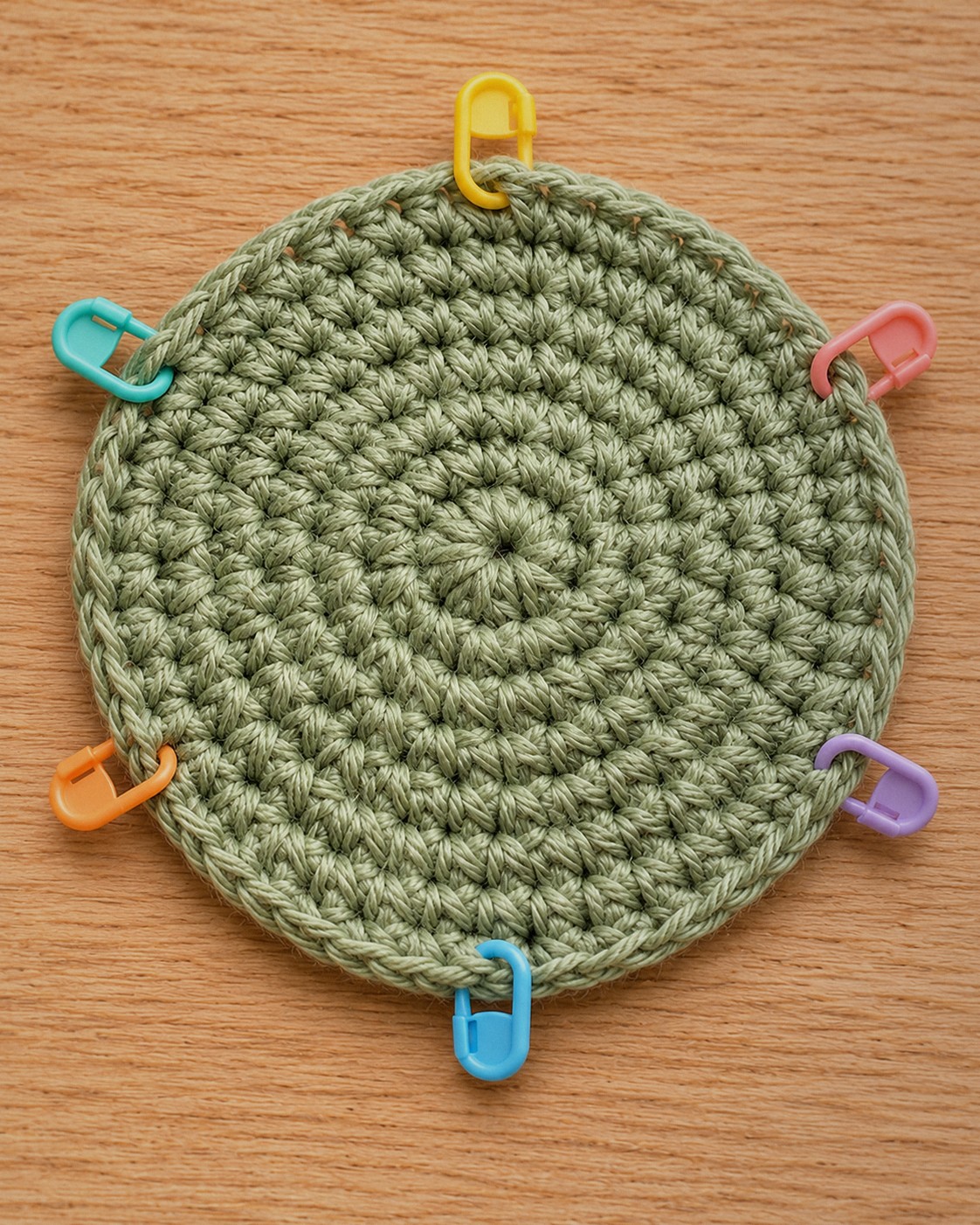
Example: the flat circle in the photos
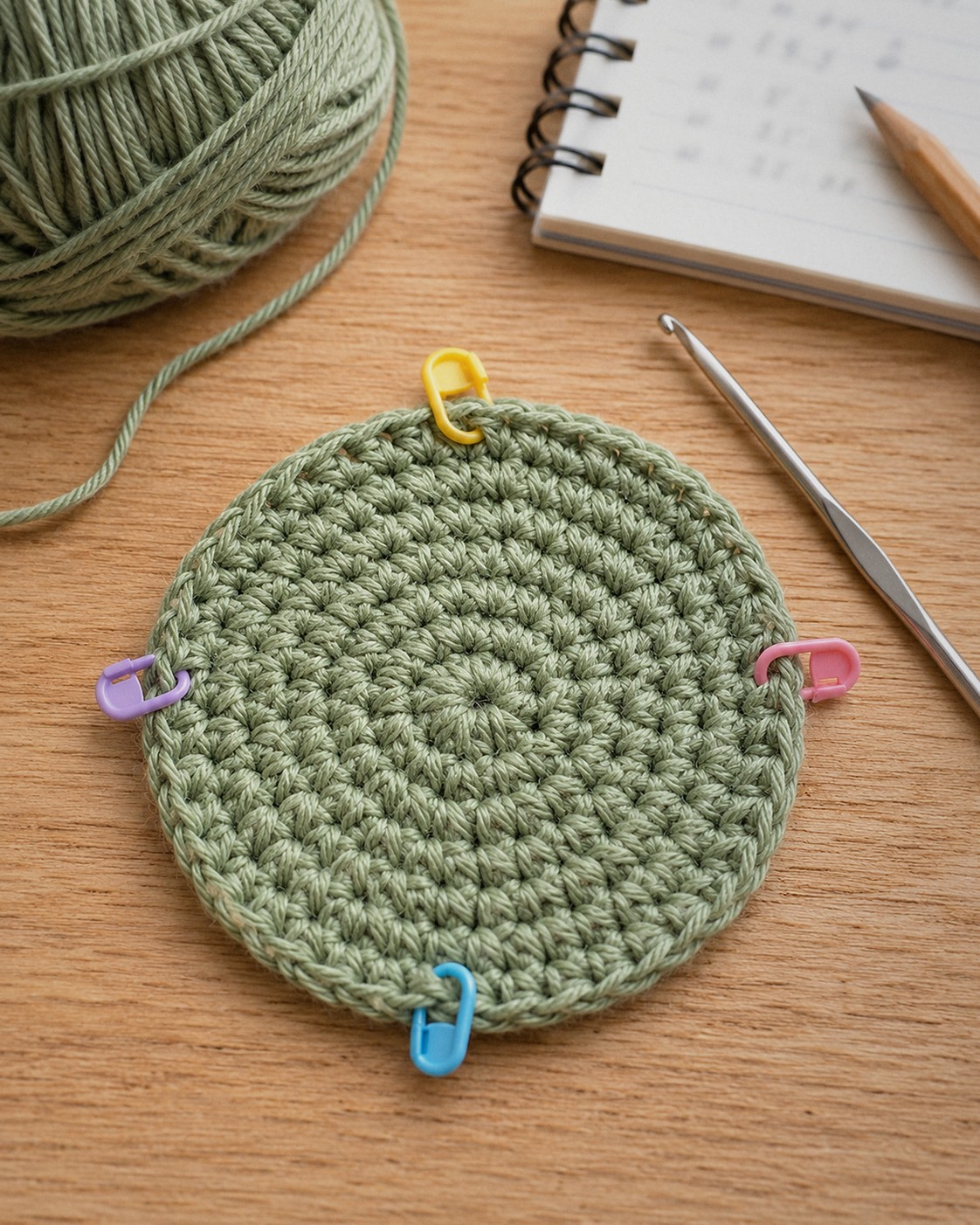
DK cotton in sage (A) and a 2.5 mm (US B/1–C/2) hook. It is about 2.5 in / 6.5 cm across and takes about 20 minutes.
Abbreviations (US terms)
- MR magic ring · sc single crochet · inc 2 sc in one stitch · dec invisible decrease · FO fasten off
- blo / flo back loop only / front loop only · ch chain · sl st slip stitch · hdc / dc half double / double crochet
Circle
Color: start with A (sage).
Exactly what the calculator writes for 6 stitches and a widest round of 48, with 0 rounds without increases.
- Rnd 1: 6 sc in a magic ring. (6)
- Rnd 2: Inc ×6. (12)
- Rnd 3: (sc, inc) ×6. (18)
- Rnd 4: Sc, inc, (2 sc, inc) ×5, sc. (24)
- Rnd 5: (3 sc, inc) ×6. (30)
- Rnd 6: 2 sc, inc, (4 sc, inc) ×5, 2 sc. (36)
- Rnd 7: (5 sc, inc) ×6. (42)
- Rnd 8: 3 sc, inc, (6 sc, inc) ×5, 3 sc. (48)
Finish: Sl st to the next st and FO; it should lie flat.
FAQ
My circle curls up like a bowl. What is wrong?
Your stitches are tighter than the increases need. Go up half a hook size, or use 8 stitches in the ring. If it ripples like a wave, it is the other way: go down half a hook size.
Can I use it for a hat?
Yes: for a hat top, set the widest round to the stitch count your hat pattern needs, with 0 rounds without increases, then follow the hat pattern for the sides. Our guide to reading crochet patterns explains the shorthand.
New to amigurumi? Start with the magic ring and our beginner guide, then try a crochet ball.