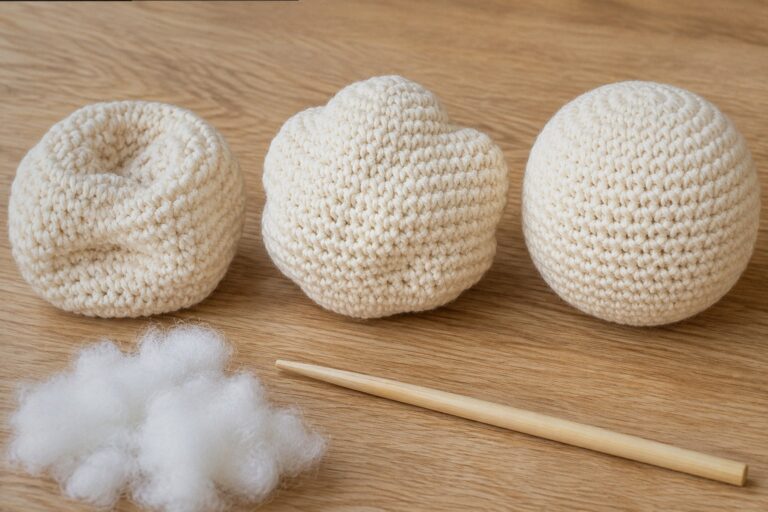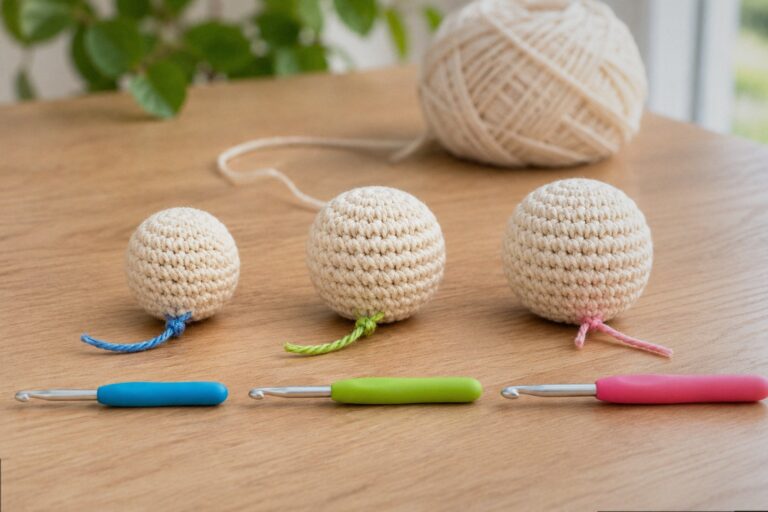
A crochet ball is the first shape every amigurumi maker learns, and the one that shows every small mistake. Stack the increases in the same place each round and you get a hexagon. Decrease with regular sc2tog and you get little holes. Stuff it in big clumps and it comes out lumpy. This pattern fixes all three, and the size chart below gives you a round ball from 1.3 in to 3.2 in across.
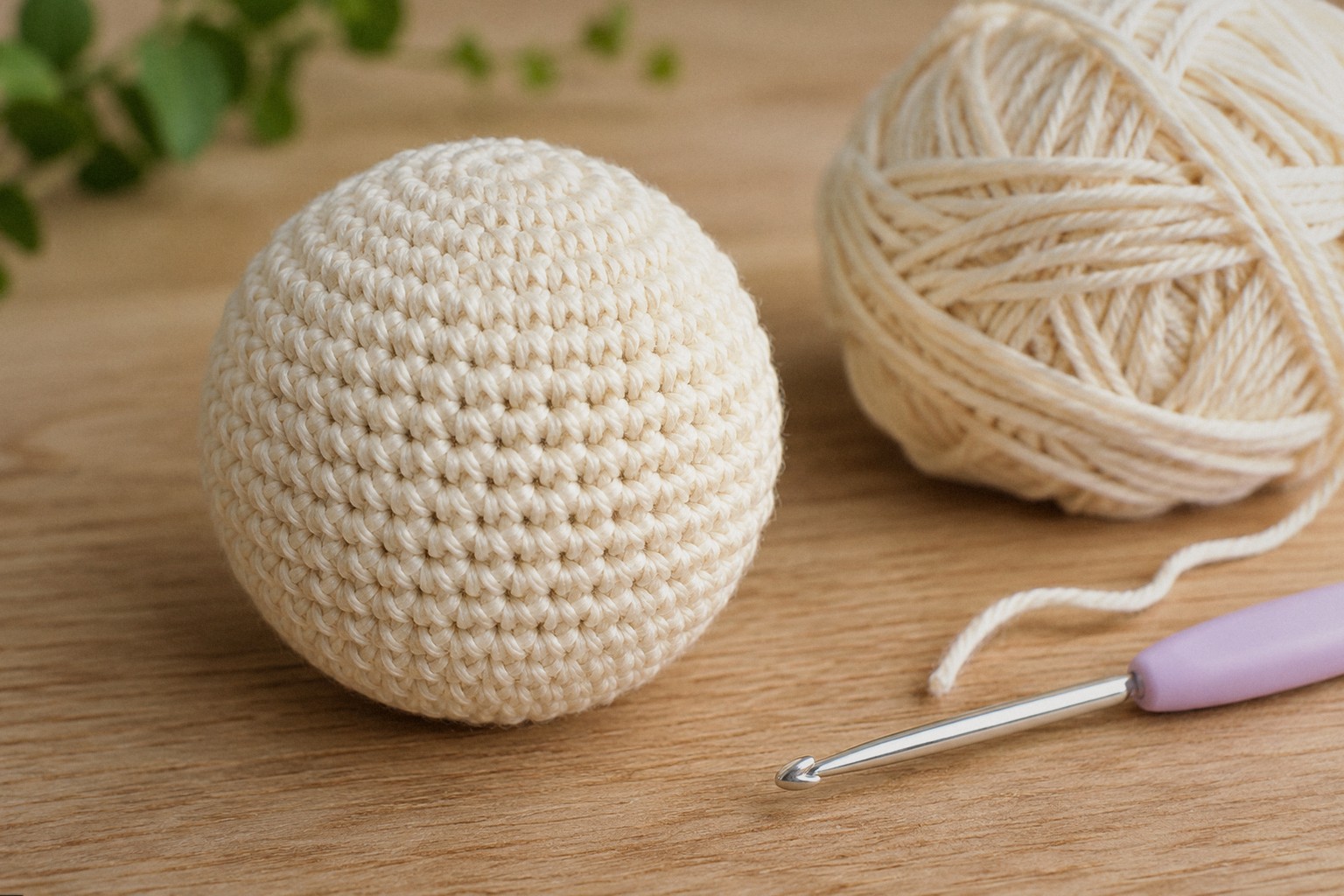
The main pattern is a 2.2 in / 5.7 cm ball, about the size of a ping-pong ball, with 42 stitches at its widest.
In this post8 sections
Pattern at a glance
- Skill level: easy (MR, sc, inc, invisible dec)
- Finished size: about 2.2 in / 5.7 cm across
- Yarn: DK cotton, about 31 yd / 28 m in total
- Hook: 2.5 mm (US B/1–C/2)
- Time: about 45 minutes
Materials
- DK cotton in any color, about 31 yd / 28 m
- 2.5 mm hook, stitch marker, tapestry needle, fiberfill
Abbreviations (US terms)
- MR magic ring · sc single crochet · inc 2 sc in one stitch · dec invisible decrease · FO fasten off
- blo / flo back loop only / front loop only · ch chain · sl st slip stitch · hdc / dc half double / double crochet
Three things that make a ball round
1. Move the increases
Each round starts the repeat in a different place: round 4 begins with one sc before the first increase, round 6 with two, and so on. The increases never line up, so the ball doesn’t grow six corners.
2. Use the invisible decrease
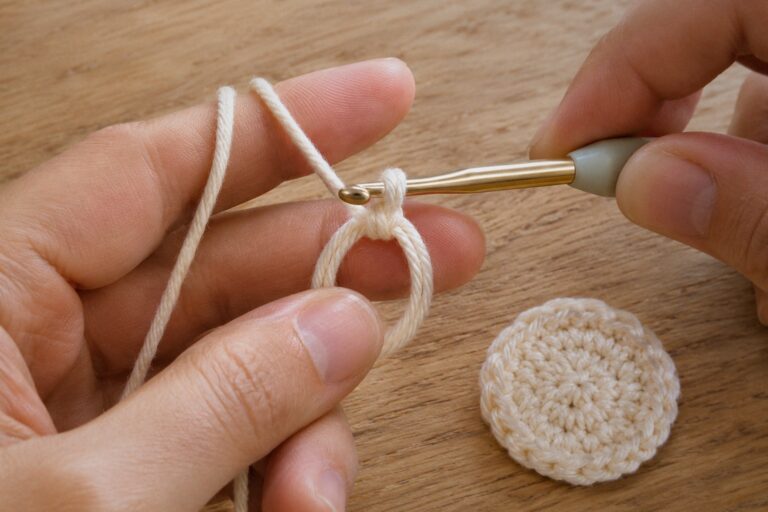
Insert the hook through the front loops of the next two stitches, yarn over, pull through both front loops, then yarn over and pull through both loops on the hook. It is flatter than a normal sc2tog and leaves no gaps.
3. Straight rounds equal to the increase rounds
A ball with 6 increase rounds needs about 6 straight rounds in the middle. Fewer and it looks flat like a disc; more and it becomes an egg.
For the stuffing side, see our guide to stuffing amigurumi evenly.
The pattern: 42-stitch ball
Ball
Color: start with A (cream).
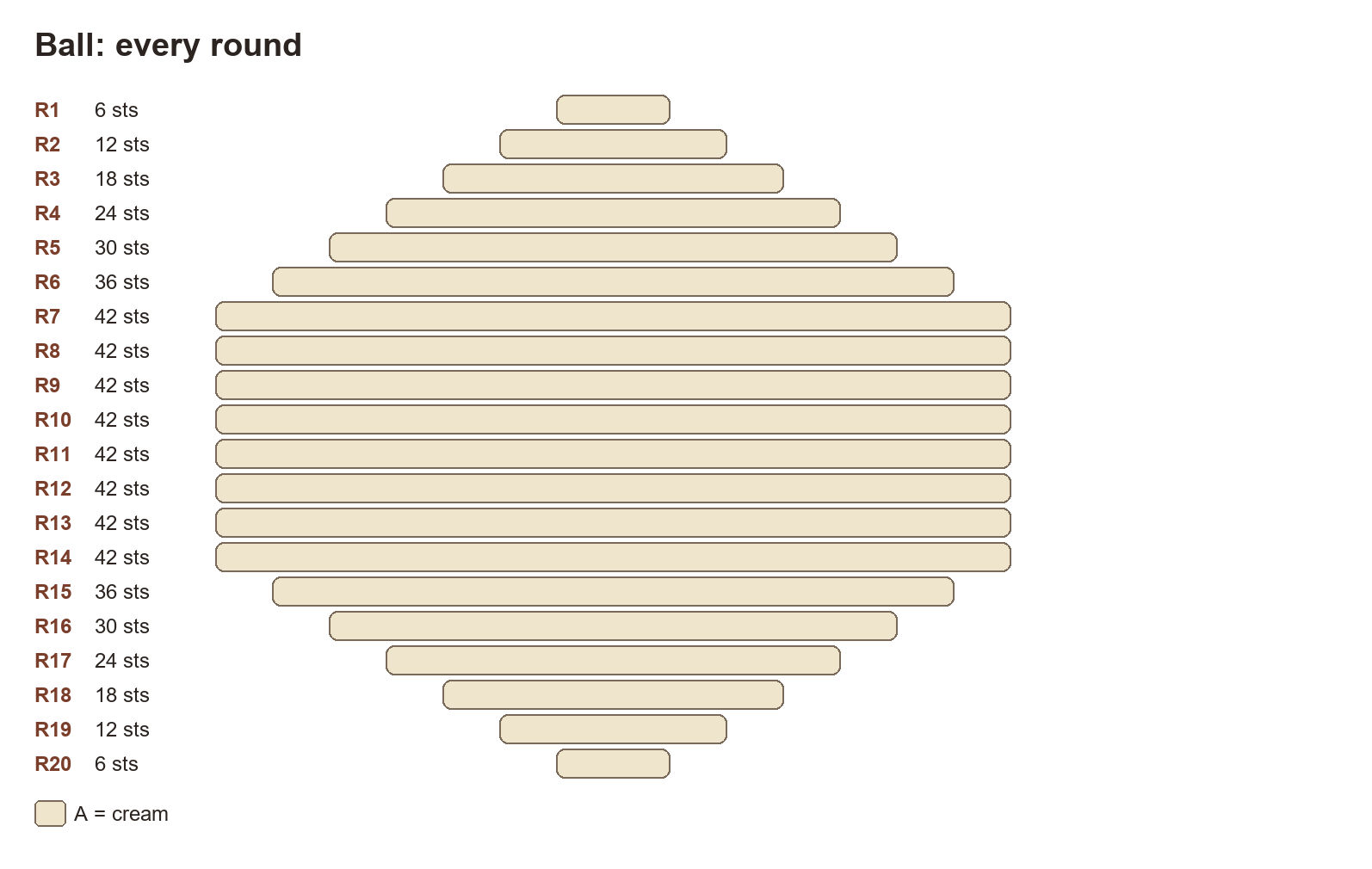
- Rnd 1: 6 sc in a magic ring. (6)
- Rnd 2: Inc ×6. (12)
- Rnd 3: (sc, inc) ×6. (18)
- Rnd 4: Sc, inc, (2 sc, inc) ×5, sc. (24)
- Rnd 5: (3 sc, inc) ×6. (30)
- Rnd 6: 2 sc, inc, (4 sc, inc) ×5, 2 sc. (36)
- Rnd 7: (5 sc, inc) ×6. (42)
- Rnds 8–14: Sc around. (42)
- Rnd 15: (5 sc, dec) ×6. (36)
- Rnd 16: 2 sc, dec, (4 sc, dec) ×5, 2 sc. (30)
- Rnd 17: (3 sc, dec) ×6. (24)
- Rnd 18: Sc, dec, (2 sc, dec) ×5, sc. (18)
- Rnd 19: (sc, dec) ×6. (12)
- Rnd 20: Dec ×6. (6)
Finish: Stuff after R18 and again after R19, FO and close through the front loops.
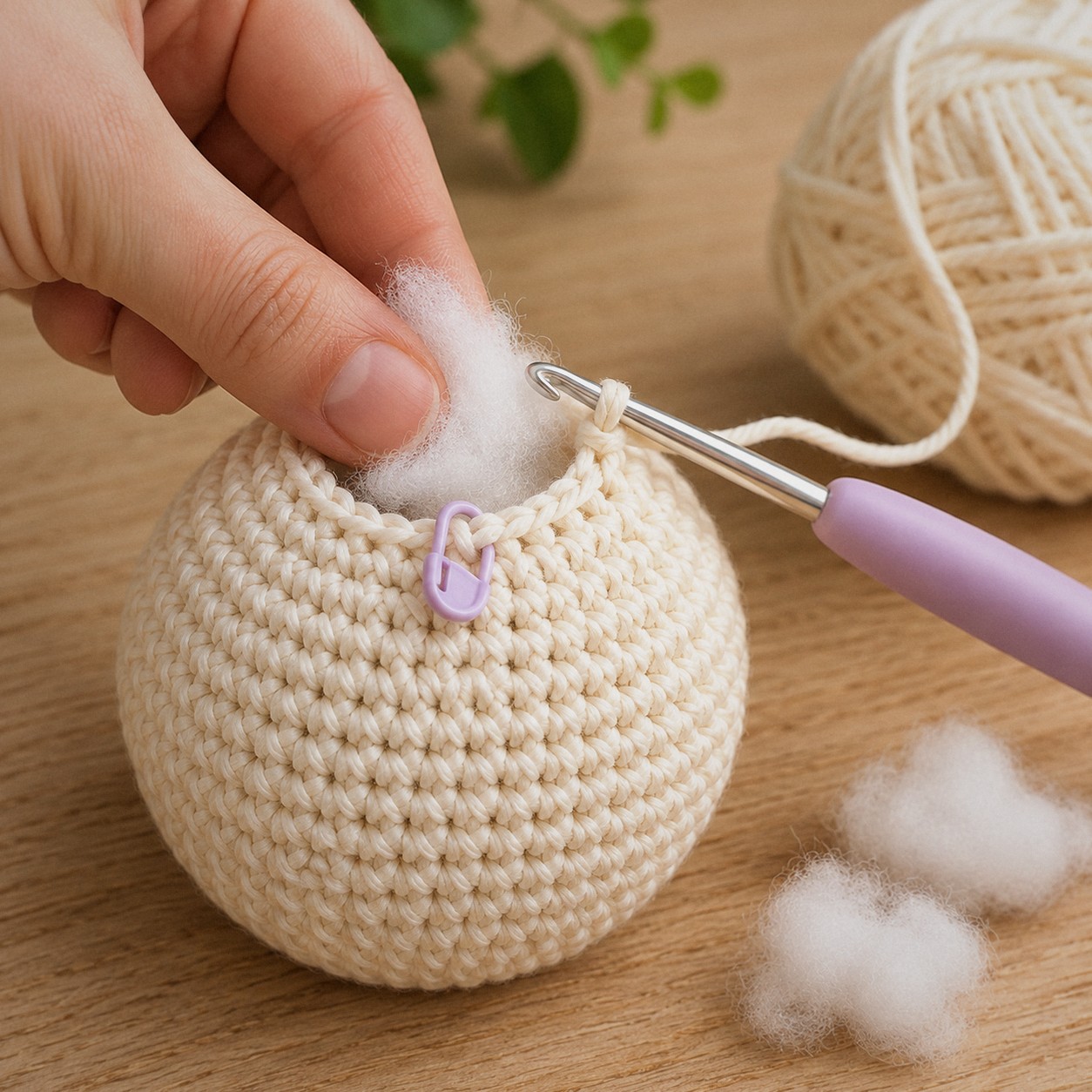
Ball size chart
Every size follows the same rule: increase by 6 stitches a round until you reach the width you want, work the same number of straight rounds as you had increase rounds, then decrease the same way back down. All of these were counted and checked; sizes are for DK cotton and a 2.5 mm hook.
| Widest round | Straight rounds | Total rounds | Size | Yarn |
|---|---|---|---|---|
| 24 | 4 | 11 | 1.3 in / 3.2 cm | 11 yd / 10 m |
| 36 | 6 | 17 | 1.9 in / 4.9 cm | 23 yd / 21 m |
| 48 | 8 | 23 | 2.6 in / 6.5 cm | 41 yd / 37 m |
| 60 | 10 | 29 | 3.2 in / 8.1 cm | 63 yd / 58 m |
The 42-stitch ball above sits between the 36 and 48 sizes. Use the small ones for heads and ornaments, the big ones for bodies and toy balls.
Uses
- A cat toy (add a jingle bell inside a small plastic capsule in the middle of the stuffing).
- A Christmas bauble: see our bauble patterns.
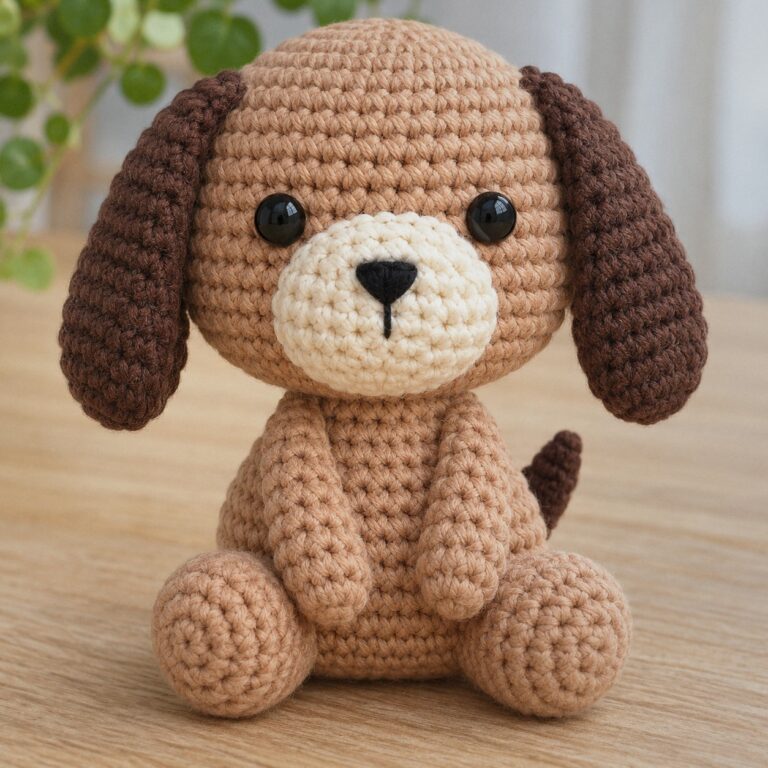
- The head of almost any amigurumi: our cat and puppy heads are a 36-stitch ball.
FAQ
Why is my ball still a little pointed at the top?
That is usually the magic ring. Pull the tail very tight and weave it back through the first round. Our magic ring guide has the details.
Can I make a ball in rows?
Not a smooth one. Working in the round without joining is what gives the even surface.